Product Design
ELEPHANT HEALTHPAY
The 2024 World Malaria Report shows Nigeria accounts for 31% of global malaria deaths. There is funding from donors, governments and community members, but tracking the efficiency and appropriateness of malaria treatment is hard. Patients are often given treatment without sufficient testing, which can mean higher out of pocket costs for them, and increased drug resistance across the population as a whole. In 2024, we developed a proof of concept for HealthPay - a product built into our EMR, ElephantOS, designed to improve the quality and appropriateness of care for Malaria.
GOAL
Create a proof of concept to deliver scalable and quality malaria treatment support. Rapidly test incentive programs and clinical decision support interventions to find the most effective ways of increasing testing and reducing unnecessary prescriptions.
OUTCOMES
After just 5 weeks we saw:
- 48% increase in malaria testing
- 10% drop in out-of-pocket spending
- 16% decrease in unneccessary antibiotic prescriptions
WHAT
Service design
Strategy & behaviour change methodology
UI & UX design
AI integrations

Overview of solution in ElephantOS
STRATEGY & BEHAVIOUR CHANGE METHODOLOGY
From our initial research, it was clear that patients and clinicians faced multiple barriers when it came to regular testing. On the clinical side, many of these were tied to knowledge gaps, past experience overriding test results, and the prevalence of malaria impacting how symptoms are interpreted.
I used the COM-B behaviour change framework to identify barriers and explore incentive strategies to tackle them. Some were financial incentives directed at patients to increase demand for testing. Others targeted clinicians to encourage best-practice behaviours through extrinsic financial incentives or intrinsic rewards, such as praise or leaderboards. I estimated the cost of each strategy for a pilot, alongside a predicted level of engagement, to support discussions with stakeholders.
We ultimately chose an incentive model that provided a small payment to clinics for each positive test result. This approach was designed to increase testing in a meaningful way - encouraging testing of symptomatic patients, rather than promoting blanket testing of all patients.
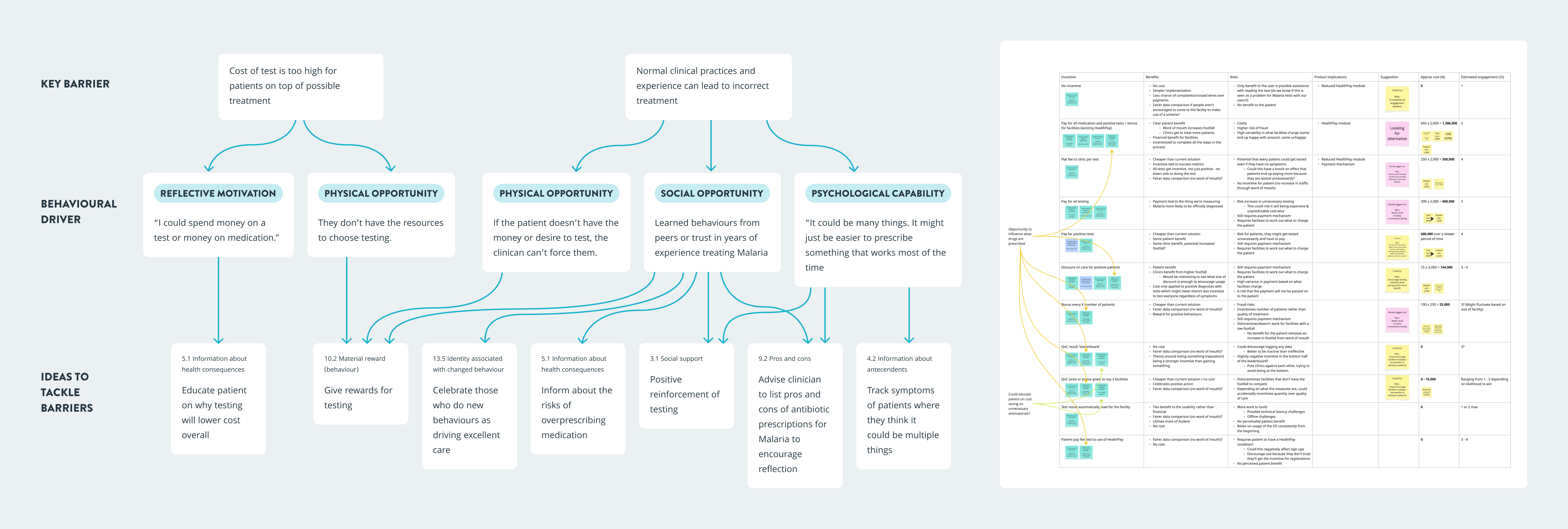
COM-B working and incentive strategies
SERVICE DESIGN
HealthPay spans the entire care experience, so our journey needed to consider everything from account creation through to dispensing medication and claims handling. I mapped the service end to end, highlighting how patients and various clinical users interacted with Elephant and other technology.
To move fast, we focused on creating the leanest, thin-slice of the service as possible. Even in this stripped back version, the service still had to handle complex real-world cases, like switching medication based on stock levels or supporting different types of diagnostic tests.

Journey map
UI & UX DESIGN
Supporting clinicians in following best practices was a core part of the design work. This meant guiding them through the right steps in a non-judgemental way. We also needed a solution that was scalable for other conditions in the future.
I explored a range of ways to guide users and we ultimately settled on a checklist component, triggered and completed by performing qualifying actions in the EMR.

Sketches and iteration
To reinforce this, we developed clinical nudges to prompt clinicians to stay on the recommended pathway. In future iterations of HealthPay these nudges became varied in visual strength based on our confidence in the required action.
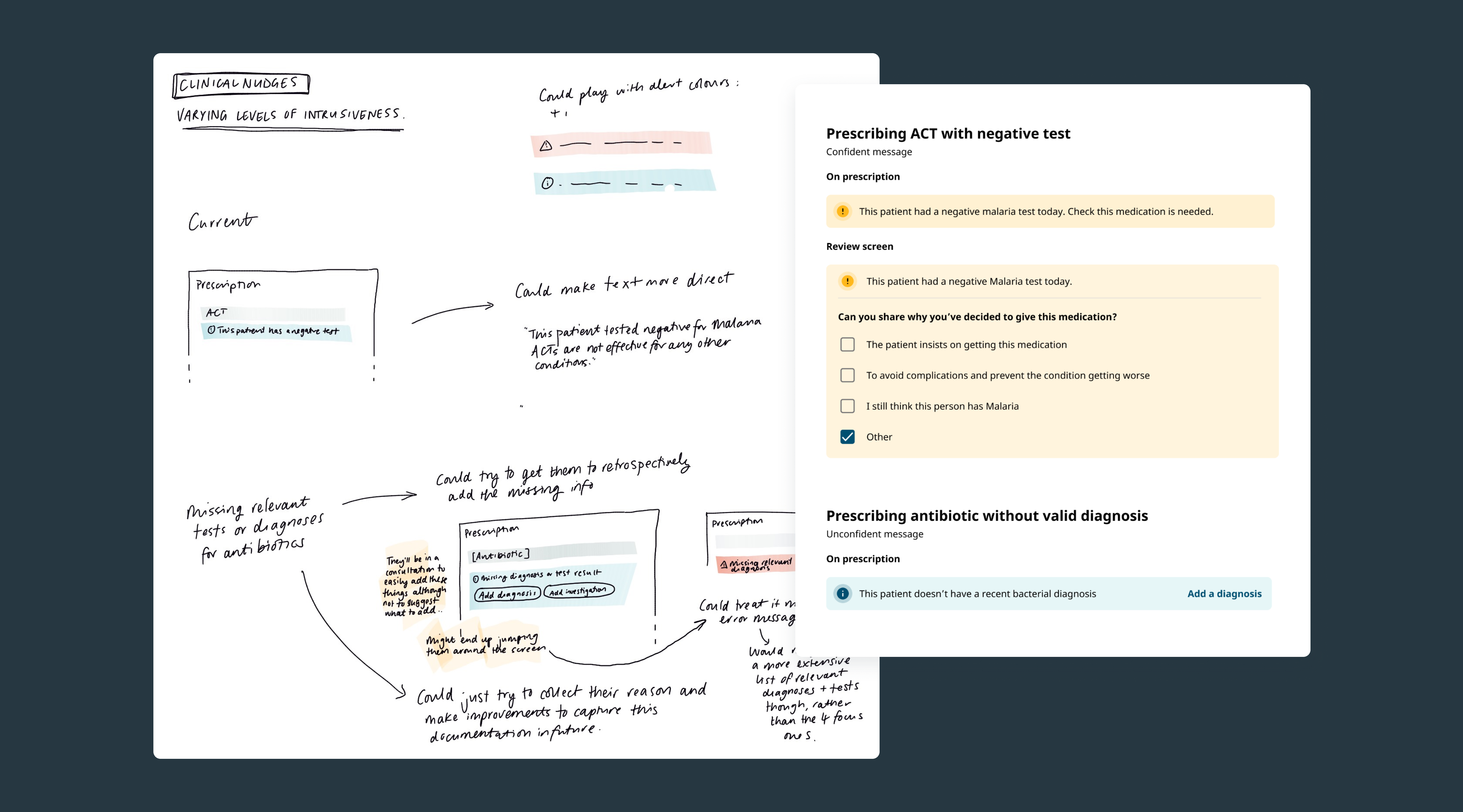
Clinical nudges development
AI INTEGRATION
To improve diagnosis accuracy and the quality of data we partnered with Audere, integrating their AI-powered solution for instant validation of rapid diagnostic test results. This required us to collect images of completed tests to send to Audere’s AI, making sure users had captured the whole cassette in the photo.
Instead of integrating this step into the checklist, we made image capture a confirmation step when a test result is recorded. This helped to prevent the lab technician forgetting and accidentally discarding the test cassette before it was documented.
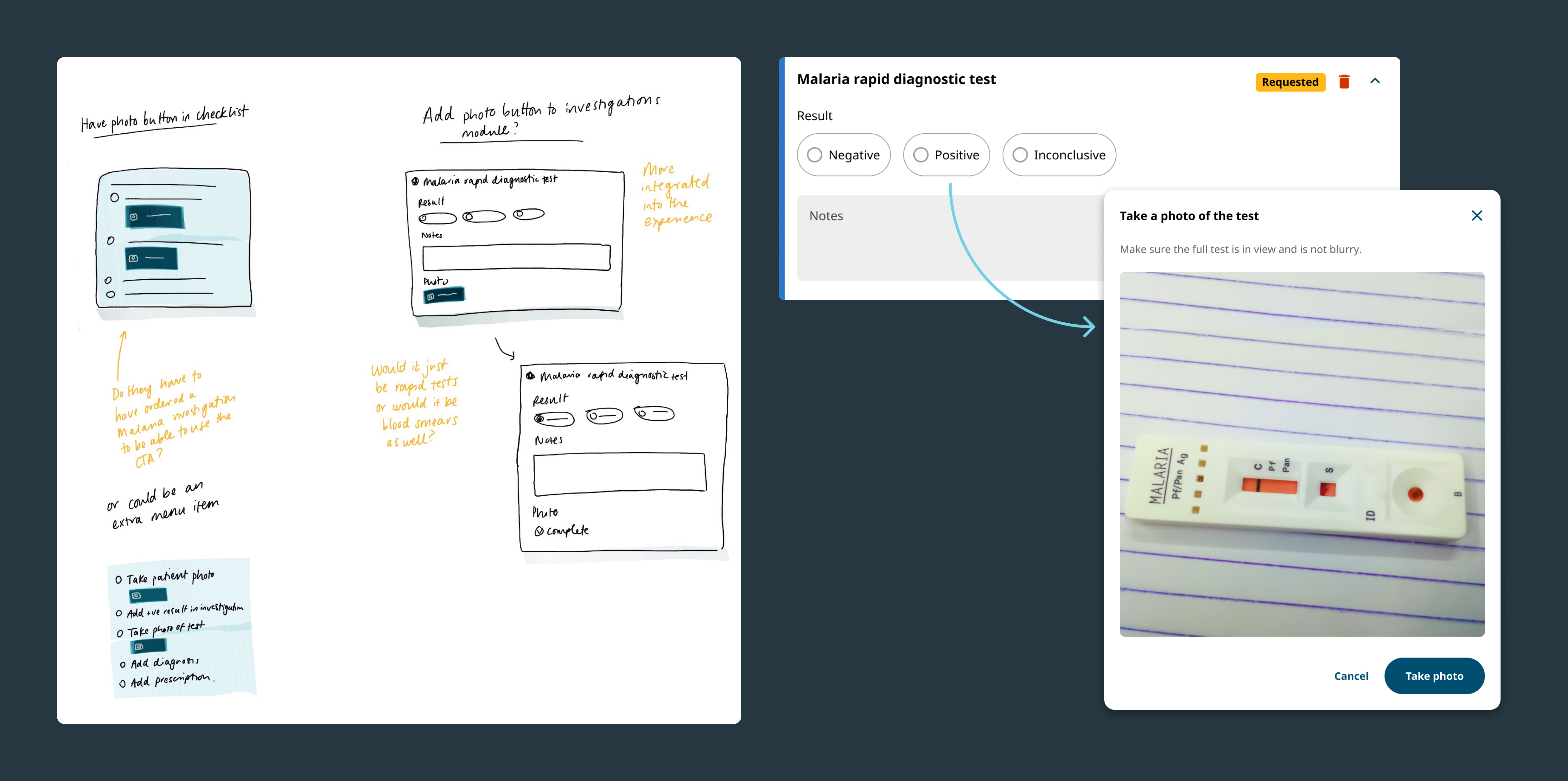
Integration designs
OUTCOMES
During the proof of concept we saw several improvements to adherence to clinical guidelines for both testing and prescribing. We went on to use HealthPay for more conditions that present with fever as a symptom.
48%
increase in malaria testing
10%
drop in out-of-pocket spending
16%
decrease in unnecessary antibiotic prescriptions


